



North Korea: From Axis of Evil to hot new tourist destination!
Well it took me over six months but I finally finished typing up the notes on my trip to North Korea. This is a rather long read but well worth it (if I do say so myself) -- a rare and incredible eye-witness account that will probably make you think that you have actually been there yourself.
****
Well it took me over six months but I finally finished typing up the notes on my trip to North Korea. This is a rather long read but well worth it (if I do say so myself) -- a rare and incredible eye-witness account that will probably make you think that you have actually been there yourself.
****
August 31, 2008: Ashley, my son's wife Laura and my six-month-old granddaughter Mena are currently stuck up in the mountains near Yosemite with a broken-down car. "Our car caught on fire, we have no way home and we forgot the tent poles so we are camping out in a lean-to right now," said Ashley on the phone the night before last, "but other than that, we're having a wonderful time." And I haven't heard from them since.
But I did hear from someone who has been working on some visa arrangements for me for the last six months -- and I finally just got approved! Yaay! Next week I will actually be leaving for a certain mysterious Asian country that I've been dying to visit since forever. "Your visa just came through," said my arranger. "You leave next Wednesday." I'm up for that.
"But I don't think it's a good idea for you to be telling anybody about this trip," the arranger added. I won't. I promise. Just going there is more than enough. I've waited for years for this trip to happen. It's all so exciting! Not as exciting as having one's car catch on fire in the middle of a bone-dry forest during fire season...but close.
September 4, 2008: Someone just sent me a video on how to not be afraid of flying and I think it‘s actually gonna work. So far, I haven’t even been afraid of the airporter van this morning at 5 am. How courageous is that.
"Guess where my layover stop's going to be," I asked Ashley the other day. "Vancouver!" Ashley turned green with envy. When she was 12 years old, we had eaten vanilla ice cream at the Vancouver airport and it has been the benchmark for measuring ice cream quality for our family ever since. Would it still stand up to Ciao Bella gelato however? I'm about to find out. We land in Vancouver in 20 minutes.
"Fight attendants, prepare for landing...." We've already flown over Crater Lake, Mount Hood and that huge river next to Seattle. It's been a long time since I've been to the Northwest. The last time I was here was back in the 1960s when I hitch-hiked up to Eugene with some truckers who were so busy checking out my fringed leather mini-skirt that they jackknifed their truck right off the road. Seriously. Then there was the time that I capsized while white-water rafting down the McKenzie River, nearly drowned and.... Never mind. We're landing. Vancouver looks really green. But big. It’s a major port for goods coming into Canada from China -- but with big bunches of trees stuck in between all the shipyards, warehouses and cranes.
But when I got to the Vancouver airport, everything had changed. Now you walk out of the plane and right into the middle of a fairyland re-creation of a pre-Columbian Pacific Northwest forest village scene -- complete with totem poles and fishing grounds. Lovely. Welcome to Canada! Now let's get down to business. "Where's the ice cream?"
After desperately and fruitlessly canvassing the entire "new" Vancouver airport for over an hour, how am I going to be able to break the news to young Ashley? "There is no more ice cream for sale at the Vancouver airport...." That's never going to happen. How can I possibly tell my trusting and vulnerable child that a family legend has been shattered by progress and that the only thing I could find at the Vancouver airport was a vanilla-softy root beer float at the A&W concession? I'm going to have to lie and make something up.
Next comes the dreaded 11-hour flight to Beijing, with no decent inflight movies. But secretly, down deep inside, I'm still really happy to be traveling again. Except that I had forgotten how much un-fun it is to be up for 24 hours without sleep while living in airports and planes. How come I keep forgetting that? I mean really. I took that trip to Iraq less than a month ago. I guess it's like childbirth. If one didn't forget the pain, one wouldn't have any more babies. "Please step over here," the security guard at the Beijing airport told me politely. "You've got bottles of liquid in your luggage." Give me a break. I’ve got hand sanitizer and cough syrup -- less than two ounces each. But they made me drink some of the cough medicine anyway. And then they ran my purse through the X-ray machine five different times. My freaking emergency granola bar is going to be radioactive. Plus playing the little-old-lady card here didn't work either.
The Beijing airport is fabulous, all organized and everything and has lots of faux marble floors. And while I was waiting for my connecting flight to Shenyang, I tried to take a nap on said faux marble floor -- totally disgracing little old ladies everywhere. Between the bottles of liquid at the security checkpoint and the nap on the floor, little old ladies everywhere have lost some serious face due to me.
But the Beijing airport got its revenge. While shamelessly lying about on the faux marble, I got bitten by fleas.
"You have a four-hour layover before your flight leaves for Shenyang," they said at the desk. Four hours? Falling asleep on the floor of Gate 51 isn't working. Time to resort to reading John Grisham.
One exciting thing happening at this airport is that, this week people are flying in from all over the world for the 2008 para-Olympics -- and the life-sized advertising photos of runners with artificial legs, blind swimmers , martial artists in wheelchairs, etc. are truly inspiring.
If you've never been to China and still think of it in terms of communes and Chairman Mao uniforms, forget that. Think capitalism and ads for new luxury cars and Visa and Mastercard and airport shops selling Burberry and Chanel.
My mom used to wear Chanel. She and I had our differences when she was alive -- a lot of differences -- but every time I see Chanel # 5 for sale at a duty-free shop at an airport, I miss her.
September 5, 2008: Our plane to Shenyang was two hours late due to a late-summer rainstorm before takeoff, but I was still met at the Shenyang airport even though it was after 1 am by the time I landed. "I am the travel agent for your trip to the D.P.R.K.," said one of the men who met me. DPRK stands for the Democratic People's Republic of Korea, BTW. "You're not a writer, are you?" asked the travel agent.
"Er, ah, no," I giggled and stammered and blushed. "At least I'm not a professional writer. Nobody's ever PAID me to write." Not that I wouldn't mind getting paid.
And then suddenly I was back at the Chilbosan Hotel. I love the Chilbosan. I'd been stuck there for two weeks back in April, hopelessly waiting for my visa to the DPRK to come through. "Jane, it's so nice to see you again," said one of my friends on the staff. Wow! They remembered me. But then how could they forget me, the sweet little old lady that they had helped to keep out of jail -- twice.
Tomorrow I will leave for the DPRK. "The cities are nice," said one person I had talked with on the plane up from Beijing, "but the people in the countryside are starving -- over a million have died." I'm not listening! I want to be able to write only nice things about the DPRK. There are enough bad things to write about back in America. I don't have to fly half-way across the world to dig up some dirt. I can find enough outrage in the U.S. caused by Bush and Cheney to last me a lifetime. This is supposed to be a vacation!
"The rural people aren't allowed to go into the cities. Otherwise there'd be too many homeless," my fellow passenger had continued. Nope, I don't want to know. So I tuned the guy out and just concentrated on writing my next blog, regarding why John McCain flip-flops so much during his election campaign.
September 6, 2008: I thought that I had already learned everything there is to know about Shenyang last April but apparently there’s a bunch of new stuff going on. "We hosted the soccer part of the Olympics this August," someone at the hotel said. “People came here from all over the world to watch the games. We built a whole new stadium.” And we trundled off to see some of Shenyang’s major tourist attractions -- museums, palaces and parks. This place used to be the capital of the Manchu dynasty before it moved to Beijing. Plus Shenyang is a major gateway to North Korea so there's a whole bunch of gossip floating around here about the mysterious DPRK. Because it’s so isolated and nobody really knows much about it, it tends to create a whole bunch of speculation. "But the people there are really nice," one Australian ex-pat I met at a local café told me, "which is surprising, considering their history of having suffered great destruction and war for most of the last ten centuries."
Apparently the country was taken over and brutally oppressed by the Japanese, starting even before World War II. Then for 20 long hard years after the Japanese occupation, Korea fought back with an intense guerrilla movement led by Kim Il Sung, who was sort of the George Washington/Fidel Castro/Chairman Mao of North Korea, as the whole country became one huge merciless battlefield -- similar to Guadalcanal and Dunkirk.
"Then finally peace came and the DPRK began to normalize -- but that didn't last long. The Americans then launched a total invasion that killed approximately one-third of the population that was left after having survived the brutal Japanese occupation." Then after that, North Korea struggled to recover from decades of carnage by cutting itself off from the rest of the world -- much like an injured animal might crawl away to nurse its wounds.
How many countries in the world today have survived 40-odd years of constant warfare and social disintegration and come out of it without any battle scars or PTSD? None that I can think of. What would America be like after 40 years of brutal and continuous war? Would we all be trusting and smiley-faced and looking like the inhabitants of Disneyland? Or would we look more like Somalia or the DRC? Given their history, it's rather amazing that the citizens of the DPRK can even walk and chew gum at the same time.
What am I getting myself into?
Then there are the stories about the city vs. the countryside in the DPRK. "I've heard," said another person, "that they have large walls around the major cities to keep out the poor." That's scary.
Anyway, it’s 4:00 am and I'm hunkered down in the bathroom of my Shenyang hotel, trying to keep from waking up my roommate but still trying to avoid just lying there in the dark, staring at the ceiling, unable to sleep. I hate jet-lag.
At 1:00 pm today, our tour group will fly off to the DPRK. I have no idea what that place will be like. We've heard so many horror stories about Cuba but when I actually went there, I found that the place was charming. The DPRK may be like that. Or it might just be a horrible police state. Or maybe it might be like America -- where there is lots of façade but with homelessness, ghettos and the world's largest prison system lurking in the background, unseen by tourists. We'll soon see.
And did I tell you that I'm really glad to be back in Shenyang? I missed Shenyang!
Maybe I should pop off to the 24-hour internet cafe down the street. I mean really. How long can I comfortably sit here and read on the toilet seat? Maybe I could take a bath? Is it time for breakfast yet? If I went back to bed, could I sleep?
"During the Korean War," another person told me, "America dropped 1.5 bombs PER PERSON on North Korea. One third of the population was killed. More bombs were dropped on North Korea than were dropped in all of World War II." That's a freaking lot of bombs.
"That experience has unified all North Koreans so that even though there are a lot of negative economic pressures on North Koreans, they still maintain this unity against the outside world which has done such terrible things to them." That puts a new perspective on things.
Also we were told that we will need to ask permission to take photos in the DPRK, especially of soldiers and military installations.
Then we ate a special pre-flight lunch at our hotel, featuring four or five platters with different kinds of mushrooms. "These ones are called 'ear mushrooms'." But what are the other kinds? Who knows. And then they brought in a huge platter of duck. Ah, the duck!
Getting our group to the airport was a challenge. "Where's Amanda, Jan and John?"
"They left their luggage back at the hotel by mistake." Would they make the plane on time? They did. Once on board, our stewardesses were six of the most beautiful young women I'd ever seen in that role. And then all six of them all got into a big argument -- while speaking Korean -- about where I was supposed to sit. Bizarre. My seat number was 26F but I ended up sitting up in row 4. But, heck, after spending the last six months trying to get a visa to North Korea, at least I was finally on the plane and didn’t care where I sat. DPRK. here I come!
Maybe they needed to balance the plane?
North Korea from the air is a very green and lovely country -- like Ireland or something. Our plane flew in over miles and miles of verdant farmland -- with the fields surrounded by what looked like electrified fences. But I didn't see any cattle. Then just before we landed, I looked over at the window next to me and there was smoke coming out from around the edges. "Fire!" I cried. OMG, we're all gonna die! But we didn't. I never did find out what that was about. Then we landed at the Pyongyang airport.
At the airport, much to my surprise, everything there looked totally NORMAL. You coulda been in any mid-sized airport anywhere in the world. "What were you expecting? That North Koreans were going to have horns and tails?" Yeah. And I guess I was also expecting the airport to look like the Stone Age or something. Sure, it wasn't as fancy as the Beijing airport -- but it was NORMAL. Airline counters, computers, restaurants, souvenir shops and customs agents. No bunkers, tents or grass huts. And no little green men.
At the airport, much to my surprise, everything there looked totally NORMAL. You coulda been in any mid-sized airport anywhere in the world. "What were you expecting? That North Koreans were going to have horns and tails?" Yeah. And I guess I was also expecting the airport to look like the Stone Age or something. Sure, it wasn't as fancy as the Beijing airport -- but it was NORMAL. Airline counters, computers, restaurants, souvenir shops and customs agents. No bunkers, tents or grass huts. And no little green men.
Then we got on a bus just like the bus that took us to the airport in Shenyang -- just like the bus that takes people to the airport in San Francisco. The DPRK appears to be westernized, up-to-date, modern and NORMAL. Get over it, Jane.
I guess that the U.S. media's efforts to turn North Koreans into "The Other" has worked, even on me. But why am I so surprised that North Koreans are just normal people like the rest of us? I found out in Israel/Palestine that not all Palestinians were mad bombers and in Afghanistan I discovered the Afghans were the nicest people on earth. And even in Iraq and Zimbabwe I found lots of new friends.
By the time we got done going through customs and getting our luggage at the Pyongyang airport, it was already dark and there wasn't much to see on our ride to the hotel. I'm really looking forward to seeing the city in daylight.
"You notice that all the buildings appear to be built relatively recently?" someone asked. Yes. And they all look alike too. "That's because most of the buildings here were flattened by the Americans back in the 1950s. The entire city was destroyed." There are no really old buildings here.
And I had somehow thought that everyone here would be wearing native dress. Not true either. Everyone is wearing western-style clothes. Not many cars. And it's a warm evening and everyone is out walking.
"There's a revolving restaurant on top of our hotel," said our guide. "And as you can see, there are many tourist buses in the parking lot -- so remember your bus number." Buses for tourists? The DPRK is a tourist destination? Does nobody besides me think that is weird? And the hotel was even more strange -- a 46-story four-star hotel set up to accommodate thousands of tourists. And all this in a country that is supposed to be poverty-stricken. No signs of poverty so far.
"I want to go to the big 60th anniversary celebration," I argued over dinner.
"I want to go to the DMZ!" pouted one man in our group. Apparently we can do both.
September 7, 2008: This is it. We're actually driving around the DPRK in a tour bus. So far, the entire city seems to be composed of Soviet-style housing blocks, Soviet-style massive monuments and Soviet-style office blocks.
"Today we are going to go to a Buddhist temple and climb a mountain," said our guide, as we drove through the streets of Pyongyang. Everyone who lives here seems to be walking everywhere. There are very few cars. "But we do have a subway. It's the deepest one in the world -- 120 meters deep." All the people we drive by look relatively happy, look like they could be walking down the street in one of San Francisco's Asian communities. I still can't get over how normal it all looks here -- in a country that has been totally cut off from the world for the last 60 years. I wonder where they get their clothes? Wal-Mart or JC Penney, it looks like.
Today for breakfast we had fish and tofu and omelets and fruit. I'm not a morning person. I put my purse on the chair on one side of me and my jacket on the chair on the other side of me and proceeded to play solitaire so that no one would bother me. Does that make me a bad person?
"Today we drive 160 km -- about two hours -- to Mount Myohyang. It is one of the country's five famous mountains. It is 800 meters high." So far I love the DPRK! The only things I haven't liked so far were the mosquitoes that flew into my room last night -- how do mosquitoes fly up to the 26th floor? -- and the wake-up call loudspeaker at 6 am that seemed to be designed to wake up the entire city.
The streets are very wide here. Tree-lined. Avenues. Greenery. Parks. Lots of high-rises and open spaces. Did I mention that the capital city has three million residents? But it's not congested. Why not? There's hardly any cars.
This place is so GREEN.
I've decided that my basic attitude toward the DPRK is that, "The enemy of my enemy is my friend." The North Korean leaders appear to not like Bush and Cheney. Hey! I don't like Bush and Cheney too!
This place is so GREEN. Did I mention that already? I will miss all this green-ness when I leave. It just makes America look so cluttered without all this open space and park-like atmosphere. Perhaps, in the end, trees are better architectural amenities than things.
"Our rainy season is in July and August. We also grow corn, rice and beans." Soy beans. "Potatoes, cabbages and radishes."
Now we're out in the countryside. It's lush. Poplars and birches line the roads -- giving the countryside an almost French flavor. Not that I've ever actually been to the French countryside. "23 million people live in the DPRK." Maybe this place might be more like Vermont, however, because I hear that it has relatively harsh winters.
"Some areas are covered with snow in the winter." One guy in our group is a skier. "Yes, we have a sky resort." I'm not interested at all. I went skiing once when I was in seventh grade, discovered that snow was cold and never went back.
"The universities, factories, farms, etc all are run by the government." Sounds like China 30 years ago. And just look at China now.
According to the Lonely Planet guide, 30% of the DPRK's budget goes to the military. In America, however, it is 54% -- and rising.
Did I mention that the freeway to the mountain is bordered with flowers? Marigolds, cosmos, daisies, black-eyed-susans, poppies, columbines. Gladiolas. Lovely.
More corn fields. And rice fields, a lush green highlighted by white cranes. I bet they don't have to deal with Monsanto shoving genetically-modified seeds down their throats here.
On one level, I am well aware that the DPRK is pretty much a dictatorship but on another level, I like that everything seems so -- organized. And un-complex. I wouldn't mind living here, out in the country, for the rest of my life. It's so peaceful -- as long as I didn't have to get my hands dirty a lot. And I would definitely miss having DSL.
Speaking of DSL, I miss young Ashley and baby Mena. And my son Joe. There's nothing like going half-way around the globe to cause one to miss one's family. "Wanna see a photo of my grandchild?" I've already asked everyone in my group. Twice.
We’ve been driving for an hour through some of the most bucolic countryside ever. And on a four-lane freeway -- two lanes each way. And we have yet to see another car. Works for me. Imagine a whole country that pretty much runs successfully without cars. Heck. That's the wave of the future. North Korea appears to be doing fine without cars. So now we know that it's do-able.
In America, we are being choked to death by cars.
I think that the DPRK has something very important to teach Americans. But who would have thought it would be that?
In North Korea, the average citizen's basic identity doesn't come from what kind of car he or she drives. Sure, it would be nice to have a car, but without owning a car, their basic sense of who they are is still secure. Or words to that effect. You know what I mean.
"80% of the territory in the DPRK is mountainous area," said our guide.
Apparently last year the DPRK suffered from major flooding and there was much damage to the crops. International aid organizations sent food and all tourist groups ere cancelled for a few weeks. Apparently canceling the tourist groups had a big impact because there is a growing tourist business here in the summertime, especially involving Australians and Europeans. But Americans? Not so much. "It's harder to get in here if you are an American." Tell me about it. It took me six whole months to get a visa. Yet another country added to the list of those who have been antagonized by Cheney and Bush.
"No, you are wrong, Jane," said someone in our group. "It's a list of countries that have been antagonized by every president since World War II ended and American industrialists took over America." Well, let's not argue about that. We'd have to go back to Teddy Roosevelt and beyond if that were the case.
And I've always wondered who I would have left to write about once Bush and Cheney are gone. Hey, no problem. If John McCain gets elected, I'll have him to hate on for years to come! Sigh.
Then we arrived at the mountain -- only it was a series of mountains. "Next we will go to the International Exhibition Hall." It had lots of marble walls and bronze doors. "Here are exhibited the gifts received by our Great Leader Kim il Sung -- sent from the leaders of countries all over the world." It was like a giant antique store. There were lots of vases and sculptures and paintings and clocks. Ceremonial swords. A chandelier from Kuwait. A miniature crystal train set from Russia. A rhinoceros horn from Zimbabwe. Fascinating.
But wait. There's more. There was a roomful of cars. Joe Stalin sent the Great Leader a knock-off Rolls Royce bullet-proof car. And a Russian pseudo-Buick, a Rumanian pseudo-Packard and the Overseas Korean Organization sent a 1962 right-hand-drive Mercedes. "The Russian car from Stalin is handmade, weighs 16 tons and is currently worth one billion dollars."
The next room contained photos of all the wildlife received by the Great Leader, sort of a photographic zoo. Giraffes. Zebras. Monkeys. Lots of peacocks. Then there was a gallery of plant photos, another roomful of vases, silverware, paintings, statues, scrolls, lacquerware, mirrors and -- oh look! There's a piano.
Then there was the Southeast Asian room. Buddhas from Cambodia, stuff from Vietnam. Balinese puppets, batik from Indonesia.
More rooms, more gifts. North Korean school children, my tour group and me all tried to take this all in. "It would take all day and all night to see it all," said our guide -- so we hurried along. "This exhibition hall was built in 1978." Then there was another large room, holding what turned out to be "souvenirs". Now we were just hurrying through room after room. OMG! There's a whole train! One coach was from Joe Stalin and one coach was from Chairman Mao. Next? A roomful of European gifts. Beer steins, pewter flatware, Greek statues, Viking boats, knick-knacks. Ah, the African room. Then the Latin American room. And a silver plate from Billy Graham. Go figure.
"Then this is the last room, containing a statue of our Great Leader," a wax figure dressed in real clothes. Very life-like.
But wait. There's more. There's a whole other exhibit hall next! Will there be food involved at the end?
The second exhibit hall was all constructed of marble too and contained gifts given by various heads of state to Kim Jong Il, the Dear Leader. And one lady in our group was feeling weak so they brought her a wheelchair. But she wouldn't take it. Too embarrassed? Not me! "I'll use it!" I gots bad knees. I'm glad I did. It was a long freaking walk through the next several halls.
Now we get more modern. Wide-screen TVs, makeup kits, a new Hyundai with gold-plated antennas, several plush sofas, a video camera. A bedroom set? Yeah. Computers. Now these are gifts you can use. A sound system.
I'm thinking that I should do some exploratory palm-reading on some North Koreans -- check out their life-lines to see how long they live, how healthy they are and that whole quality-of-life thing. But here I am in this wheelchair. I should be reading my own freaking life-line. Plus you can't just go up to people and say, "Hold out your hand."
A very interesting-looking group of North Koreans just walked by but they were keeping their hands close to their vests.
Afterwards we went up to the observation deck on the roof of the hall and some high school boys offered me their chair. Boy I really have reached little-old-lady status.
At lunch we all trotted out stories of near-death experiences. One group member had been in Thailand during the tsunami. Another had been on a plane during an emergency crash-landing. I told my story about almost getting blown up at the Iraqi parliament.
Next stop: A 400-year-old Buddhist temple. They had some big-ass old statues of various bodhisattvas. 20 feet tall. Carrying swords and trampling demons. Then a bunch of gilt Buddhist statues, etc. And a very holy-looking monk who I was totally honored to meet. Highlight of the trip -- so far.
Then I was forced to deal with a squat toilet.
Tomorrow we are going to a world-famous circus. Hey, this is supposed to be some hard-scrabble nation that's been demonized as being totally evil -- not the latest hot tourist destination!
"Let's cut short our visit to the Buddhist temple and go hike up the mountain," someone suggested and then everyone got all excited except me. Will I get a wheelchair on the mountain too?
Sure, the country folk here have a hard life. But all around them lies the beauty of nature. But there are other countries in the world where people live in even prettier places -- like in the DRC -- yet they have no education, no healthcare and no physical or economic security. Plus in the DRC, women there face the horror of rape every single day of their lives.
And there are even more than several places in the USA where this is all true too -- no education, no security, no healthcare. Plus the voting machines don't even work.
The only real danger I've faced in the DPRK so far has been from mosquitoes.
But in all honesty, I can't really say if the people in the countryside get free healthcare like the people in Pyongyang do. But I'm assuming that they get education because one of the school groups we met at the Great Leader's Exhibit Hall were obviously children raised in the country. They all had farmers' tans.
Even though the trail up the mountainside wasn't very primitive -- it was paved with asphalt -- I had to stop half-way up and fall by the wayside and contemplate some rocks for about an hour while the rest of the group persevered on up to a magnificent waterfall of epic proportions. How do I know? they all showed me their photos of it.
Then there was also a weekend camping event for children up on the mountainside and the kids were all happy and smiley-faced and cute. The future of a country is always pointed out through its children and these ones looked like they had a bright future. Good.
On the long bus ride back to the city, we only saw one checkpoint while nearing the capital and it was mainly just a table and chair, manned by one person. This is a hecka big difference from, say, the checkpoint outside of Ramallah in Palestine. THAT checkpoint is totally out of control -- ten football fields wide and taking all day to get through.
Back in Pyongyang, it was after dark. Night in the capital city is weird. Imagine Washington DC with no cars and not streetlights -- but lots of trees and parks and people strolling around. The low levels of energy use in this country never cease to amaze me. This is definitely no Las Vegas. They simply do not pig out.
At dinner, we had fun telling each other ghost stories about all the rumors, innuendos and hot gossip we'd ever heard about current and past leaders of the DPRK. "The Lonely Planet said that the life of a political prisoner here was 'hell on earth'." Is this still true? Or have things mellowed out? Sometimes as things get better economically, the old, harsh ways relax -- as new generations who have experienced happy childhoods grow up. Too bad that the opposite seems to be happening in the U.S.
"And remember the famines? I heard that a million people died of starvation." I'd heard that too -- that things got so bad in one province that they just sealed it off one winter and came back in the spring to see if anyone had survived.
Then there are the stories about how the past president had been dead for five years before anyone in the DPRK was told, or that the current president was dead and some actor had taken his place -- like the stories they tell about Fidel Castro and Saddam Hussein. Then there are the kinky stories. You gotta love kinky stories. Which brought up the stories about George Bush and that former male prostitute who spent 20 nights in the White House -- and don't even get me started on Sarah Palin stories!
September 8, 2008: Aha! The Lonely Planet has set us straight. "Surprisingly, the presidency rested with [the dead president even after his death was announced officially], making him the world's only dead head of state." So. He WAS dead while still president. But everyone here also knew he was dead too.
And apparently, according to several other tourists I’ve talked to – there are tons of tourists here! – the 1995 floods and resulting famines WERE extreme and extremely large numbers of people did die. “Stories of stunted children with swollen bellies fighting over grains of rice in the mud are famous all over the world.” What a fascinating and complex place this is! And today we are going to see even more of it. And two days from now we’ll be back in China and four days from now I’ll be home playing with baby Mena and buying gelato from young Ashley at her job. Wow.
But first I gotta get up and go off to breakfast. And figure out what book to read on the bus.
“I am SO not a morning person,” I profusely apologized to my wonderful roommate. I thought I had given her the room key and that she had gone off for a walk and left me locked out, so I waited outside our door and inwardly stormed and raged at the injustice of it all. Crap. I had to pee!
“But, Jane,” she reminded me, “you have the key.” And I did. In my pocket. I’m just all burned out. This has been a hectic seven days. I’m losing it. I seriously considered spending the day hiding under the bed today but I’d better not. I’d just hate myself when I got back to Berkeley – that I didn’t take the tour of the capital city and ride on the world’s deepest subway.
I read some more from the Lonely Planet guide. “Trying to get a sense of day-to-day life is a challenge indeed. It’s difficult to overstate the ramifications of half a century of Stalinism – and it is no overstatement to say that this is the most closed and secretive nation on earth. Facts meld with rumor about the real situation in the country….” But you gotta admit that the rumors and gossip here are first class!
Then we ran into a tour group of Canadian corporate executives that had come here for a tennis and golf vacation!
According to the Lonely Planet, up to three million people died of starvation during the 1990s floods. That’s almost one in seven North Koreans. That’s sad. And apparently this place has a three-caste system, based on political attitudes. If you are hostile to the government, you might end up in a labor camp. That’s almost like when Bush fired all those U.S. attorneys in America who didn’t support the neo-can regime.
“The ‘neutrals’ have little or nothing and generally live the hard lives of farmers out in the countryside but they are not persecuted, while the ‘loyals’ enjoy many more material things.” They get to live in the capital city, have access to education, don‘t have to perform strenuous physical labor for the most part, and are not in any danger of starving. And at the top, according to the Lonely Planet, there is also a fourth caste. “The Kim dynasty and its vast array of courtiers, security guards, staff and other flunkies are rumored to enjoy great wealth and luxury.”
But what is the real truth here? Guess what? I’m definitely not going to find out in only four nights and five days.
The DPRK has the world’s fifth-largest standing army, according to Lonely Planet. Plus people who join the army have a higher status here.
It’s now Monday morning in North Korea’s capital city and people are walking and biking to work. Get over it, America. Don’t be so snobbish. You’re next. I bet you anything that, if it keeps going the way our economy and environmental limitations are now heading, in ten years America will be like this too – less cars, less electricity, more rationing, more militarization and more Stalinism. We may even pass the DPRK on our way down – or it may pass us on its way up.
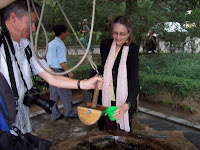
Next stop? The birthplace of the country’s first president, Kim Il Sung. “I have heard that if you drink water from this well three times,” another tourist told me after we got there, “you may become rich and the president of the country. But if you drink it four times? You may get loose bowels.” Apparently this is a well-known joke in the DPRK.
We then met a tourist group from Denmark that was going to be here for eleven days. Then we got back on the bus and drove past a Ferris wheel and a fun fair and several five-story buildings and an electric streetcar line. “Is Kim Jong Il married?” asked someone from our group. Kim Jong Il is Kim Il Sung’s son and he obviously must have drank at the well three times. “I heard that his first wife died, he remarried and has several children.”
“I don’t know about that,” answered the guide. That would be like Americans not knowing if George was married to Laura or not or if they had any children. Maybe I misunderstood.
“Next we are going to visit the Pyongyang subway system, completed in 1973. It runs on over 35 kilometers of track and has 17 stations.”
A sign on the subway wall read, “If the Americans invade our country, we will defeat them.” Too late. We’ve already invaded! The tourist invasion.
The escalator down to the subway platform went so deep that my ears popped. Twice. And we were given free reign to take photos. Yaay! Now I can show the folks back home how well-dressed everyone here is.
I’m still fascinated by the clothes here. The shoes are stylish and some of the ladies are almost chic in a WalMart sort of way. Where do these clothes come from? Are they made here? Made abroad? Who designs them? Do they put out a DPRK Vogue?
“The clothes are made here.” I’m impressed. They don’t dress as fresh-off-the-boat here as one would think. The women don’t, that is. With regard to the men, they are like men in most of the rest of the world – they don’t pay that much attention. Geeks and nerds. You’d think you were at M.I.T or something except I didn’t see any pocket-protectors.
Then our bus actually got stuck in traffic. That’s a first for Pyongyang.
One member of our tour group said that the U.S. has frozen the DPRK’s assets outside of the country and they are not even allowed to buy food from the outside world with it. That’s cold -- especially since I just read in the Lonely Planet that as many as 15 million people may have starved to death in the 1990s. That’s totally cold. 15 million dead of starvation? I could make a bad joke here about how at least the North Koreans were respectful enough not to resort to cannibalism because if they had, not that many people would have starved. Sorry. That’s not funny at all. There is NOTHING funny about 15 million people starving to death.
OMG! There’s a woman with pants on! And then it suddenly hit me that all the women here wear skirts. I hate wearing skirts. They don’t have pockets.
Having to wear skirts is so 1950s.
Then we stopped at a HUGE monument “to the workers”. It was very Stalinist but a hecka photo op.
Some sweet older man who speaks no English is following our group around with a video camera and documenting our trip. “How much will the video cost?”
“40 euros,” said our guide. Around $70? I could afford that. But what if I get it home and the video doesn’t work on American machines?
Next comes the DPRK war museum. I almost got in a fight with my guide about that. “The Lonely Planet says that North Korea started the war.”
“No! No! No!” the guide practically screamed. “The Americans started it!” We are about to find out who is right. After all, Bush swears up and down that Saddam Hussein is responsible for the Iraq “war” disaster. And even Hitler blamed the Poles for his Blitzkrieg. Show me the proof.
BTW, our lunch was the best we’ve had so far. Hot pot and tempura and beer. Plus I got a bunch of dolls for souvenirs – six dolls for $10 total.
Apparently, right after World War II the U. S. military moved in and seized the area south of the DPRK from the Japanese, killing 478,000 North Koreans in the process. I’ve never heard that before. This is interesting, to hear the view of the North Koreans. And the Americans continued to threaten a full invasion of all of the DPRK.
The war went on from 1950 to 1953. According to our guide, these were grisly times, as General Walker ordered as many people in North Korea as possible killed by American troops. They were bombed, slaughtered, dropped down mine shafts, buried alive, whatever. The DPRK’s capital was leveled. And even women and children fought back.
Americans used chemical bombs. Napalm. The an article from the New York Times said, “The use of napalm far exceeds its use in World War II…. The U.S. Army’s chemical corps shipped more than 17,000,000 pounds of napalm to the far east.” Five times the amount of napalm used in World War II. They also dropped bombs containing poisonous insects – and fleas. Fleas?
Then we saw several airplanes and the torpedo boat that sank the USS Baltimore, and an auditorium-sized mechanized panorama of DPRK soldiers sneaking guns and equipment across a mountain pass while under aerial bombardment. I got a photo of a famous MIG jet prototype.
There were photos of an all-woman anti-aircraft hunting team and we saw many of the planes that they had shot down, perhaps 20 or 30. That made me sad -- that so many Americans had to die in that useless senseless war. And it also brought home to me that North Korea was a country that had continually experienced war devastation at a level that Americans can only try to imagine.
September 8, 2008: Aha! The Lonely Planet has set us straight. "Surprisingly, the presidency rested with [the dead president even after his death was announced officially], making him the world's only dead head of state." So. He WAS dead while still president. But everyone here also knew he was dead too.
And apparently, according to several other tourists I’ve talked to – there are tons of tourists here! – the 1995 floods and resulting famines WERE extreme and extremely large numbers of people did die. “Stories of stunted children with swollen bellies fighting over grains of rice in the mud are famous all over the world.” What a fascinating and complex place this is! And today we are going to see even more of it. And two days from now we’ll be back in China and four days from now I’ll be home playing with baby Mena and buying gelato from young Ashley at her job. Wow.
But first I gotta get up and go off to breakfast. And figure out what book to read on the bus.
“I am SO not a morning person,” I profusely apologized to my wonderful roommate. I thought I had given her the room key and that she had gone off for a walk and left me locked out, so I waited outside our door and inwardly stormed and raged at the injustice of it all. Crap. I had to pee!
“But, Jane,” she reminded me, “you have the key.” And I did. In my pocket. I’m just all burned out. This has been a hectic seven days. I’m losing it. I seriously considered spending the day hiding under the bed today but I’d better not. I’d just hate myself when I got back to Berkeley – that I didn’t take the tour of the capital city and ride on the world’s deepest subway.
I read some more from the Lonely Planet guide. “Trying to get a sense of day-to-day life is a challenge indeed. It’s difficult to overstate the ramifications of half a century of Stalinism – and it is no overstatement to say that this is the most closed and secretive nation on earth. Facts meld with rumor about the real situation in the country….” But you gotta admit that the rumors and gossip here are first class!
Then we ran into a tour group of Canadian corporate executives that had come here for a tennis and golf vacation!
According to the Lonely Planet, up to three million people died of starvation during the 1990s floods. That’s almost one in seven North Koreans. That’s sad. And apparently this place has a three-caste system, based on political attitudes. If you are hostile to the government, you might end up in a labor camp. That’s almost like when Bush fired all those U.S. attorneys in America who didn’t support the neo-can regime.
“The ‘neutrals’ have little or nothing and generally live the hard lives of farmers out in the countryside but they are not persecuted, while the ‘loyals’ enjoy many more material things.” They get to live in the capital city, have access to education, don‘t have to perform strenuous physical labor for the most part, and are not in any danger of starving. And at the top, according to the Lonely Planet, there is also a fourth caste. “The Kim dynasty and its vast array of courtiers, security guards, staff and other flunkies are rumored to enjoy great wealth and luxury.”
But what is the real truth here? Guess what? I’m definitely not going to find out in only four nights and five days.
The DPRK has the world’s fifth-largest standing army, according to Lonely Planet. Plus people who join the army have a higher status here.
It’s now Monday morning in North Korea’s capital city and people are walking and biking to work. Get over it, America. Don’t be so snobbish. You’re next. I bet you anything that, if it keeps going the way our economy and environmental limitations are now heading, in ten years America will be like this too – less cars, less electricity, more rationing, more militarization and more Stalinism. We may even pass the DPRK on our way down – or it may pass us on its way up.
Next stop? The birthplace of the country’s first president, Kim Il Sung. “I have heard that if you drink water from this well three times,” another tourist told me after we got there, “you may become rich and the president of the country. But if you drink it four times? You may get loose bowels.” Apparently this is a well-known joke in the DPRK.
We then met a tourist group from Denmark that was going to be here for eleven days. Then we got back on the bus and drove past a Ferris wheel and a fun fair and several five-story buildings and an electric streetcar line. “Is Kim Jong Il married?” asked someone from our group. Kim Jong Il is Kim Il Sung’s son and he obviously must have drank at the well three times. “I heard that his first wife died, he remarried and has several children.”
“I don’t know about that,” answered the guide. That would be like Americans not knowing if George was married to Laura or not or if they had any children. Maybe I misunderstood.
“Next we are going to visit the Pyongyang subway system, completed in 1973. It runs on over 35 kilometers of track and has 17 stations.”
A sign on the subway wall read, “If the Americans invade our country, we will defeat them.” Too late. We’ve already invaded! The tourist invasion.
The escalator down to the subway platform went so deep that my ears popped. Twice. And we were given free reign to take photos. Yaay! Now I can show the folks back home how well-dressed everyone here is.
I’m still fascinated by the clothes here. The shoes are stylish and some of the ladies are almost chic in a WalMart sort of way. Where do these clothes come from? Are they made here? Made abroad? Who designs them? Do they put out a DPRK Vogue?
“The clothes are made here.” I’m impressed. They don’t dress as fresh-off-the-boat here as one would think. The women don’t, that is. With regard to the men, they are like men in most of the rest of the world – they don’t pay that much attention. Geeks and nerds. You’d think you were at M.I.T or something except I didn’t see any pocket-protectors.
Then our bus actually got stuck in traffic. That’s a first for Pyongyang.
One member of our tour group said that the U.S. has frozen the DPRK’s assets outside of the country and they are not even allowed to buy food from the outside world with it. That’s cold -- especially since I just read in the Lonely Planet that as many as 15 million people may have starved to death in the 1990s. That’s totally cold. 15 million dead of starvation? I could make a bad joke here about how at least the North Koreans were respectful enough not to resort to cannibalism because if they had, not that many people would have starved. Sorry. That’s not funny at all. There is NOTHING funny about 15 million people starving to death.
OMG! There’s a woman with pants on! And then it suddenly hit me that all the women here wear skirts. I hate wearing skirts. They don’t have pockets.
Having to wear skirts is so 1950s.
Then we stopped at a HUGE monument “to the workers”. It was very Stalinist but a hecka photo op.
Some sweet older man who speaks no English is following our group around with a video camera and documenting our trip. “How much will the video cost?”
“40 euros,” said our guide. Around $70? I could afford that. But what if I get it home and the video doesn’t work on American machines?
Next comes the DPRK war museum. I almost got in a fight with my guide about that. “The Lonely Planet says that North Korea started the war.”
“No! No! No!” the guide practically screamed. “The Americans started it!” We are about to find out who is right. After all, Bush swears up and down that Saddam Hussein is responsible for the Iraq “war” disaster. And even Hitler blamed the Poles for his Blitzkrieg. Show me the proof.
BTW, our lunch was the best we’ve had so far. Hot pot and tempura and beer. Plus I got a bunch of dolls for souvenirs – six dolls for $10 total.
Apparently, right after World War II the U. S. military moved in and seized the area south of the DPRK from the Japanese, killing 478,000 North Koreans in the process. I’ve never heard that before. This is interesting, to hear the view of the North Koreans. And the Americans continued to threaten a full invasion of all of the DPRK.
The war went on from 1950 to 1953. According to our guide, these were grisly times, as General Walker ordered as many people in North Korea as possible killed by American troops. They were bombed, slaughtered, dropped down mine shafts, buried alive, whatever. The DPRK’s capital was leveled. And even women and children fought back.
Americans used chemical bombs. Napalm. The an article from the New York Times said, “The use of napalm far exceeds its use in World War II…. The U.S. Army’s chemical corps shipped more than 17,000,000 pounds of napalm to the far east.” Five times the amount of napalm used in World War II. They also dropped bombs containing poisonous insects – and fleas. Fleas?
Then we saw several airplanes and the torpedo boat that sank the USS Baltimore, and an auditorium-sized mechanized panorama of DPRK soldiers sneaking guns and equipment across a mountain pass while under aerial bombardment. I got a photo of a famous MIG jet prototype.
There were photos of an all-woman anti-aircraft hunting team and we saw many of the planes that they had shot down, perhaps 20 or 30. That made me sad -- that so many Americans had to die in that useless senseless war. And it also brought home to me that North Korea was a country that had continually experienced war devastation at a level that Americans can only try to imagine.
Then there was another squat toilet. How’s that song go? “I fall down – but I get UP!” I got down okay but….
This is getting to be a long day.
We then drove off to another monument but I just hid out on the bus.
And then the circus started. Tightrope walkers. Balancing acts. Those guys are crazy. Then they had cute little jump-roping bears and a lady who did a triple on the flying trapeze. We all clapped and clapped and clapped.
Then as our bus drove through the city, I couldn’t help but think as I watched people walk by, “These are the lucky ones – and they know it.” Lucky to be here in the capital city and not out in the countryside or off in some gulag. I forget a lot about how lucky I myself am – to be living in Berkeley, in a place of my own, and not in Iraq or the Congo or something. I forget because I rarely think about the horrors of Iraq or the Congo. But perhaps the people of the capital here know about the alleged 15 million people who starved to death just miles away from them. And, if so, I imagine that they truly appreciate how lucky they are.
I gotta learn to be more appreciative. But should I be appreciative that I don’t live here? Not necessarily. The residents of Pyongyang seem to live a pretty good life. Except for having no internet of course.
Then we went to visit a middle school. Good grief! At an assembly they were holding, two girls were playing accordions. And they were good too. The DPRK’s got talent! And some other musical groups also came onto the stage of the multi-purpose room. And they were good too. And they were having fun. Even I was having fun.
Then the students came off the stage, took our hands and taught us how to folk dance. And I have the pictures to prove it. Then we visited a classroom. About 30 kids per class. And I have the pictures to prove that too. Three girls and I practiced our English together. Our visit to the circus had been nice – but this was more meaningful.
“Now we are going to drive to the Arch of Triumph,” said our guide,” and then we will have dinner at the revolving restaurant back at the hotel.” Is it bedtime yet? I’m worn out.
September 9, 2008: “Today is our national holiday,” said our guide. “It is the DPRK’s equivalent of the American Fourth of July. And also your trip to the DMZ has been cancelled.” What! No DMZ? That’s not fair!
But apparently there are tensions in the DMZ today. Rats. I wanna see tensions.
Did I mention that last night I woke up with a really nasty cough? So I went to the hotel pharmacy and bought some cough medicine. “Today we will be traveling to a visit a dam,” said our guide after I had gotten back on the bus. “It will be an hour and 15 minute drive from here. The dam was built in the 1980s, to prevent the rivers from flooding. It cost 40 billion U.S. dollars to build.”
“Does it generate electricity?”
“No. We use coal-powered generators.”
“Do they have coal here in the DPRK?”
“Yes. Lots of coal. And lots of other metals too – such as gold, silver and iron.” So that’s what those people I saw squatting in the river on our road trip to the mountains were doing – panning for gold. I saw a one-ounce Chinese panda gold coin for sale at the hotel but it cost 1006 euros. That’s twice as much as gold costs in America. “I just bought a gold coin at the hotel gift shop for 40 euros,” I overheard someone say. Dream on. If that was real gold, we could buy it all up and be rich rich rich! I’m sorry but I don’t have that kind of money karma. If I did, I’d be down by the river panning for gold too.
Then we drove into Nampo on the way to the dam and landed right in the middle of that city’s huge September 9 celebration. The whole place had a festive atmosphere and the streets were filled with lines of uniformed school children and women in “cupcake” dresses – that’s the name that one of our group gave to the DPRK’s female national dress.
The main plaza of Nampo was filled with over a thousand people. Only DPRK nationals were allowed to attend the capital city’s September 9 celebration – maybe because the country’s president would be there – and so our tour group hadn’t been able to secure tickets. But here in Nampo, we tourists were able to attend -- if only unofficially, as our bus drove past the plaza.
Cupcake dresses, school children and flowers were everywhere.
Perhaps this city was also bombed and fought over during the DCRP-American war because so far I’ve only seen Soviet-style buildings and monuments here.
“On our left is the major river flowing down from the capital. To our right is the river’s delta and bay. And this road we are on now is the dam.” The dam appeared to be two or three miles wide. Too much water! Now I’ve got to pee.
On our right are ships and Islands. On our left are many mountains framing the shore – and some large ships. That means that there must be a drawbridge or something here so that the ships can get through to the bay. Also there are some truly jankety fishing boats here – rusted hulls, ancient engines.
Then we went to a tourist center on top of the dam and saw a video about it being built. “It was a great challenge to tame the sea but with our indomitable spirit of self-sacrifice, the wild sea has given way to man’s efforts.”
We talked with one German guy at breakfast back at our hotel this morning who said that he got his visa within five days of applying for it in Germany. I guess it’s just hard for us Americans to get visas.
Then we saw a video that demonstrated the complexities of the dam system’s locks, sluices and a revolving bridge. It took them five years to build this sea barrier – and one and a half tons of cement. It has 36 sluices. 45 million tons of cargo pass though the locks. And the whole thing is powered by its own mini-hydro plant. Also trains, trucks and cars can get easily across the huge river, the tides are controlled and the dam prevents salination of the river itself by said tides.
Then our guide took us off to a clam shack to buy freshwater clams -- but we ended up having to buy clams to go because they would have charged us extra to park the tour bus in front of the clam shack.
In the video we saw, there had been a scene with the DPRK’s president and Jimmy Carter. “Carter made a deal to take the DPRK off the U.S. short list in exchange for giving up the quest for nuclear weapons,” said a tour group member. “And then Bush came along and screwed up the deal. Now, eight years later, Bush is trying to negotiate the same deal that Carter had made back in the 1990s.”
“Was this before or after 9-11?” I asked.
“Before.” Well. That explains it. Bush’s backers were probably looking for a war even back then so that they could go on with the business of making weapons like they had in the good old days of World War II, the Korean War and Vietnam. Ah, how the Bushies seemed to long for the good old days of Vietnam!
I bet that Bush thought he could get something going with North Korea -- and perhaps even China if he was lucky. But then 9-11 happened and Bush got his wars without having to declare war on the poor DPRK.
Which leads me to believe that maybe the North Koreans might have been right after all and that Americans had also provoked the DPRK into war back in the 1950s as well. Just like Johnson lied about the Gulf of Tonkin incident to start the Vietnam war, Reagan lied about Granada to start a war there and Bush lied about Iraq. There’s a pattern here.
Then, from our bus, I spotted a pregnant woman -- and realized that she was the first one I’d seen on this trip so far.
Then we drove back to the capital and I happily chatted with someone in our tour who knew a lot about the Middle East -- until my voice gave out. So I drank some more cough syrup. How much cough syrup is enough?
“The main meal in the DPRK is lunch,” said our guide. So we sat down and ate nine courses. The restaurant also served rice vodka and rice beer. They served us kimchee, mussels, breaded veal, salad greens, pot stickers, marinated pork, stir-fried pork, red bean cakes, clear noodles with egg, beef with chard, breaded potatoes, cucumbers and rice. “Does anyone want those extra pot stickers?” I asked. No? Feed a cold, starve a fever. I just ate 14 pot stickers.
Then suddenly there we were -- at the famous American spy ship that was captured by the DPRK navy in 1968. 83 U.S. sailors were taken prisoner, including eight officers. “The boat was a civilian research vessel,” stated President Johnson, but evidence to the contrary was found on the ship -- evidence indicating that it was a military ship, spying on North Korea.
An American crewman aboard the Pueblo had stated that the ship had been ordered to sail closer to the DPRK, apparently into its actual territorial waters -- and had done this 17 times before. “The statement of President Johnson had proved to be a lie,” said a video that we saw onboard. Johnson then tried to cover his tracks by accusing the DPRK of aggression, trying to shift the responsibility to the DPRK. The U.S. threatened out-and-out war on the DPRK.
North Korea then tried negotiations, seeking an apology -- and if they didn’t get one, then the crew would be put to death. The crew members pleaded for their lives and eventually Johnson backed down and eleven months after the vessel’s capture, Johnson finally apologized. Even Johnson admitted that it was the only such apology in American history. And the U.S. promised never to do it again. Then the video showed the sailors crossing over some bridge to a pro-American country.
“The DPRK will never back down against unwarranted aggression!” said the video. But apparently the U.S. is still doing the same thing because a data-collecting American torpedo was discovered off the coast of the DPRK in 2004.
The document read, “[The United States]...shoulders full responsibility and solemnly apologies for the grave acts of espionage…and gives firm assurance that no U.S. ships will intrude again in future into the territorial waters….”
Then I got my photo taken at the wheel of the Pueblo. And then we ran into two babies the same age as my granddaughter Mena.
“Now we are going to a souvenir shop.” Good. I bought Ashley another aspiring entrant into our “World’s Ugliest Camel” contest.
At the souvenir store, like every other tourist place in the DPRK, everything was priced in euros.
“The BBC just reported that the president of the DPRK might be dead,” said one tour group member. We get the BBC in our hotel rooms. “No one has seen him since August. But if he were dead, then who would replace him?”
“He does have a son but the son apparently disgraced himself a few years ago when he was caught sneaking into the Japanese Disneyland and with a forged passport.” Sounds like a man of good judgment to me.
“The BBC also said there was a huge military parade today.” Oh, you mean the one right beneath our hotel window? The one that consisted of about 200 olive-drab-painted trucks? Apparently the trucks were going to be used to carry participants to the mass games tonight -- not a parade.
For dinner, we went to a restaurant specializing in duck. Each table had its own hibachi. We cooked and ate lots of duck. I really tried to finish it all off -- thinking it my civic duty to not let food go to waste in a country where 15 million people had starved within the last decade -- but I was totally and thoroughly defeated. Not even I could eat any more.
Then everyone sorted out their cash to tip the guides and buy the DVD that they had filmed of us and then we got in the bus to drive off to the mass games, the highlight of our trip.
And then we got stuck in traffic. Traffic? You go without seeing a car for hours at a time and now suddenly there’s traffic and we are going to miss the mass games? “Are we close enough to walk?” someone asked our guide.
“It’s not a traffic jam,” our guide replied. “It’s a military parade.” Oh. Not just the personnel carriers that went past our hotel this morning? And the BBC was right?
We still have 15 minutes before the games start. The bus finally started to move. Will we make it in time? Stay tuned.
“The mass games are one and a half hours long.” We arrived with two minutes to spare. Our bus drives right up to the entrance of a massive stadium that hold 150,000 people. Yuck. Stairs. However, I took one look through the stadium tunnel as we were coming in late, saw just a mere fraction of the grand spectacle in front of us and immediately became a believer.
“The mass games are like a cross between the Radio City Rockettes, the American Ballet Theater, the SuperBowl, a Busby Berkley movie, a circus, a flower show and a Maoist production of ‘The East is Red‘.” That pretty much sums it up. Wow.
September 10, 2008: We take the plane back to Shenyang today. But first we went to see a few more monuments. By the time we got back to the hotel after seeing the mass games last night, we were all really tired. “Tomorrow we will visit more monuments,” our guide told us before we went up to our rooms. Everyone groaned. But the monuments really were rather nice, down by the river, very low-key. We got to sit around all morning and not have to get in and out of a bus. Plus we got to people-watch.
“Have you noticed that hardly anyone wears glasses here?” I asked, being a huge fan of glasses-as-accessories myself. So we all started counting glasses. Approximately one person in a hundred wears glasses.
“And what about pregnant women? Have you seen any pregnant women here?” One. Maybe they stay home after they get pregnant.
“How much do glasses cost?” we asked our guide.
“One dollar for a pair. But if you want better quality glasses, they cost five dollars.” And that probably also includes the exam.
Last night at the hotel, something happened that I am still trying to sort out the meaning of. The BBC had announced that the DPRK’s president didn’t appear at the September 9 celebration, hasn’t been seen since last August and might be seriously ill or even dead. And apparently someone in our tour group told a North Korean that she had met in our hotel lobby about this, and the North Korean was totally horrified. Apparently North Koreans love their current president very much and this statement that he might be in poor health shocked this person to the core.
“It’s like some stranger coming up to you and informing you out of the blue that your father was seriously ill -- your father, who you dearly love.” It was really unsettling to the North Korean back at the hotel. I felt really bad for her. North Koreans feel very strongly about their current president.
Now that I think about it, I feel very strongly about the man who is currently occupying America’s White House. And if someone had just told me that George Bush was seriously ill, I too would have been devastated -- that now he might not be able to serve time in jail.
After touring the monuments and experiencing an intense hour or two of people-watching, we all went to the airport to fly back to Shenyang. Lots of tears at the departure gates. We all loved our guides.
So. I spent five days in the DPRK and what have I learned? Not much. One would have to be Suuperman and have X-ray vision to know everything about the DPRK after just five days. It is a very complicated country. But I do know that I will miss the friends that I made there very much.
Okay. No more getting maudlin. Time to focus on Shenyang. “Want to go for another massage?” asked a member of our group. Me? Turn down a cheap two-hour massage? Like that’s ever going to happen. But for the most part, the big neon-lit word that is flashing across my brain right now is “Internet Café!” I’ll have five whole days of e-mails to sort through -- over 200 a day.
September 11, 2008: Back at the hotel in the DPRK, I talked with a guy who knew more about North Korea than I did -- which isn’t very hard to do even after I just spent five whole days in that country.
“40% of the citizens of the DPRK are malnourished,” he said, “and the reason for that is that they are unskilled agriculturally.” Still and all, 40% malnourishment is way up from 40% death by starvation -- assuming that the rumors of 15 million having starved to death in the 1990s are true. The official DPRK government figure is three million deaths, so it would probably be at least double that. But in any case, that’s a whole lot of dead people.
And when I got back to Shenyang, I had 700 unread e-mails waiting. And only about five of them were important -- if you count the one from the Berkeley Public Library telling me I had a book overdue.
“Want to go for another massage?” asked someone else in our group. Sure. The last one wasn’t so hot but I’ll try again. And this one was PERFECT! I came out of it feeling all healthy and refreshed and optimistic -- and then I went off with our group to a Chinese banquet, ate for two solid hours and now I’m a physical disaster once again.
Speaking of disasters, I just e-mailed Ashley and Joe to please go pick some flowers and put them in front of our local fire station to commemorate 9-11. “Steal them out of someone’s garden if you have to but PLEEZE….” It’s not the brave firefighters’ fault -- the ones who died in New York -- that Bush and Cheney are either bumbling incompetents who couldn’t stop the disaster even after they had been warned or evil plotters who deliberately set up “another Pearl Harbor“. In either case, 9-11 should never have happened. Those firefighters should still be alive. But they are not. And I still remember them.
Last night at the banquet, I got an earful of hot gossip. “One of our tour group had a secret camera and was caught taking pictures of soldiers.” someone said. We had been asked to refrain from taking photos from the bus when we has first arrived in the DPRK, and to not take any photos of soldiers.
“This guy was seen holding this tiny camera down low and when they checked his memory card, he had about 50 photos taken from the bus and 15 of them were of soldiers and bridges. I think that he was a CIA plant,” said one group member.
The guy was stupid to do that -- or impolite at the best. He deliberately broke a clearly-spelled-out rule. What had he been thinking? He could have gone to jail as a spy. But was he actually CIA? We may never know.
“I don’t think that he was,” said another group member. “I think he was just an over-enthusiastic tourist. Plus if he actually HAD been CIA, he would never have been caught.” The DPRK authorities simply gave him a lecture and asked him to delete his memory card.
And speaking of censorship, another group member announced that Sarah Palin had just published a list of 95 books she wanted banned in the United States -- and two of them were by an author in our group! That’s hot gossip. But when I checked it out on the internet later, it said that, “Palin did indeed ask the librarian of her town if she would be willing to ban books and when the librarian said no, Palin worked to get her fired. But no specific list of books was mentioned.” I want to get MY books banned by Sarah Palin. Maybe that would kick-start my sales.
We also talked about the health of the president of the DPRK. “Yahoo News says he had a ‘circulatory problem’ in his brain and was operated on.” A stroke. How in the world do they find out stuff like that?
“Every time there’s a holiday in the DPRK,” someone else said, “American media trots out the same old story that the president is dying, ill or already dead.” Speculating on DPRK politics is endlessly fun. Speculating on ANYTHING in the DPRK is endlessly fun.
But nothing in the DPRK can ever match the shear entertainment value of speculating on politics in America.
September 12, 2008: “We walked around this area of Shenyang yesterday,” said someone in our group, “and we saw a KFC, a McDonalds, a Pizza Hut, a Starbucks and a WalMart.” No comment.
Then on the way to the airport to fly home, we passed a row of fabulous Rodeo-Drive-type stores. Armani, Gucci, and Prada were represented and also the gilt-edged Marvelot Marriot. These people are living high on the hog over here. China’s come a long way from Mao’s collective farm days.
Now I’m at the Beijing airport with only ten yuan to my name. “How much are the potato chips?”
“15 yuan.”
“Do you take dollars?”
“No.”
My flight doesn’t leave for another four hours. Will I starve to death first? Yeah. Ah, but wait! I have an emergency energy bar in my carry-on bag. But it’s been through so many airport X-ray machines since I bought it that it’s probably radioactive. That gives me at least five and a half more hours without food -- if you count in the time it takes to pass out the Sprite and peanuts inflight. Guess I’ll just have to live on body-fat. You think I’m kidding about this? After hearing that 15 million people starved to death in the DPRK, yeah, I guess I am.
The Beijing newspapers continue to debate whether or not the president of North Korea is seriously ill. Yesterday, Yahoo News said that one spy agency gave full details about the type of illness involved, the kind of surgery the president had, etc. -- a really detailed report.
However, the China Daily stated that the DPRK “has denied foreign media reports that said the president was seriously ill,” and described the reports “questioning the top leader’s health as a ‘conspiracy’.” But a friend of mine just jokingly e-mailed me that somehow I was probably the one that was responsible for making the poor president ill -- just by being in the country. Not funny at all.
I need to lighten up here. Camping out with the fleas on the floor of the beautiful Beijing airport is getting to me. This trip to the DPRK has been a wonderful experience that I will remember for the rest of my life. But right now, I need to get some sleep. I need to go home. I need some food!